Tuesday, 25 August 2015

Sea kale at Sandhaven

Sea Kale (Crambe Maritima) This striking plant is over 1 metre in diameter.
A solitary monstrous sea kale plant growing in the pebbles on Sandhaven shore. The round seed heads are held above the fleshy leaves, typical of shore plants in being thick, glaucous and bluish-green.  Sea kale, now in decline, is thought to have been the ancestor of cultivated kale and in the 19th century the blanched roots were considered to be a great delicacy. It is said to have been cultivated in Pennan and elsewhere.

The leaves are rapidly being devoured by gorging caterpillars

Sunday, 9 August 2015

New Aberdour - evolving flora

New Aberdour Shore has a shingle beach which provides a habitat for the beautiful oyster plant (Mertensia maritima). A small colony shifts about annually at the west end of the beach. The prostrate bluish grey leaves always reappear each year in  a slightly different position at the top of the beach and are followed by exquisite  flowers - pink at first then turning to blue. The lovely Grass of Parnassus grows in damp places at the eastern end of the bay. It was at Aberdour that in 1840 the first example in the Aberdeenshire of the now ubiquitous Pineapple Weed, (Matricaria matricariodes) a native of north east Asia,  was first recorded. It was thought to have arrived in the NE in a consignment of animal feed, by 1890 it was also growing at Pitsligo Castle and in Pitullie and by 1901 was said to be spreading from the seaports in 5 parishes.

There were a few meadow brown butterflies in the  long grass above the beach.
Delicate blue harebells and hawkweed at the dyke side between the mill and the village - flowers which along with the distant ripening barley fields signal the turning of the year.
In the middle of the  junction of the roads to Aberdour beach and  Pennan  a triangle of waste land has been sown with a 'wild' flower mix and provides a rich profusion of colourful flowers. Sadly in the 15 minutes or so that it took to photograph the patch not a single butterfly visited them.

The mix includes such gems as Corncockle -(Agrstemma githago), Maiden Pink ( Dianthus deltoides) on the extreme left of the picture, Cornflower (Centaurea cyanus) and Flax (Linum usitatissimum) all of which are described by Welch as rare, 'probably introduced'.There are also field poppies and a garden form of Toadflax
It will be interesting to see if these species survive and reoccur in the future.

Corncockle

Flax rarely occurs locally but is a relic of the once important linen trade in the area.

Sunday, 26 July 2015

Ythsie: Prop and Stone Circle

The curious  Prop of Ythsie, a sort of stone hybrid  between a giant chess piece and a giant pepper mill, situated about a mile to the west of Tarves, is a conspicuous landmark for miles around. I first paid attention to it when walking the Formartine and Buchan Way. 

The Prop is approached by a clear but fairly uninspiring footpath leading from a car park signed from the Tarves to Pitmedden road (B999). After muddily passing through some trees the track follows  field margins and there is a fairly steep ascent towards the Prop. The upper sections of the track are lined with dog roses, hawthorn  and enormous spear thistles. The bluebells which betoken the turning point of the year are just starting to flower.

The red granite Prop was built in 1861 by the grateful tenants of the Haddo Estate in commemoration of George Hamilton Gordon, 4th Earl of Aberdeen. A Tory peer, Hamilton Gordon served as Prime Minister from 1852 until his resignation in 1855 over the involvement of Britain in the Crimean War. He was said to have been instrumental in persuading Queen Victoria to buy Balmoral.


There are spectacular views from the Prop, here Tarves nestles in rolling fields with Bennachie in the distance.


The Prop viewed through Scots pines near South Ythsie stone circle.
South Ythsie stone circle is situated about half a mile to the south of the Prop in low lying land on the opposite side of the B999 - an area known as Chapel Fauld, possibly alluding to the old belief that such monuments were 'Druid Temples'. Missing a turning in the track on the way down from the Prop serendipitously led us to a sign pointing to the circle.
This small circle consists of six stones on a raised circular platform, at this time of year partly concealed by long grasses. The surrounding fields form peaceful amphitheatre round the circle.

Monday, 13 April 2015

Saturday, 4 April 2015

'And these also are Spring'


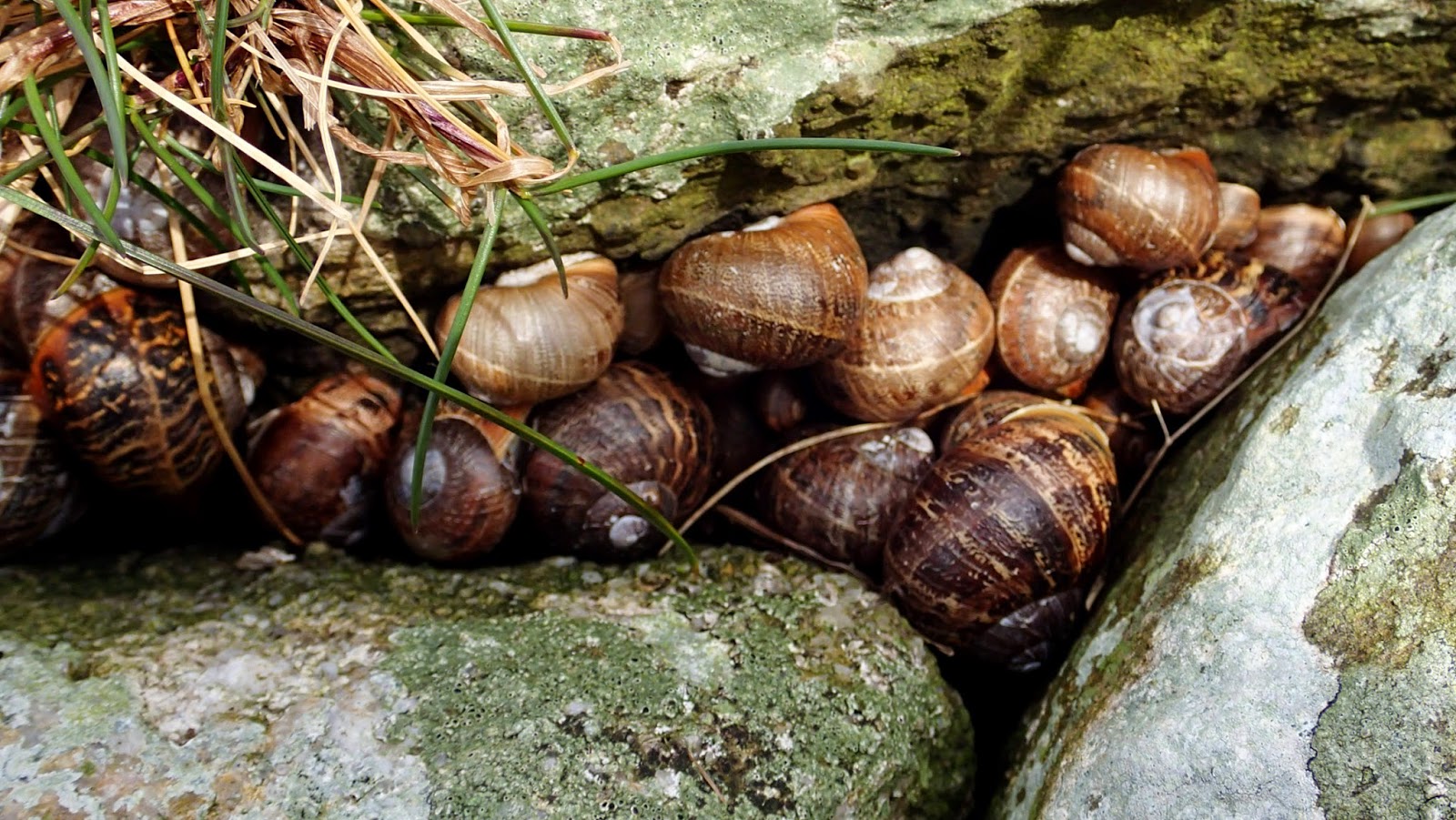
A huddle of snails still hibernating in the crevices of  a south facing dyke
The bright ribbon of dykeside whins 
Clumps of daffodils
The first flowers of coltsfoot

Celandines reflecting the sunlight
The strange mysterious flowers of butterbur

And the gradual greening of Pitfour


Friday, 3 April 2015

Old St Peter's Kirkyard Peterhead


The kirkyard is situated on a steep slope overlooking Peterhead Bay. It is dominated by the bell tower, seen here behind the remains of the chancel of the mediaeval St Peter's Church.

The chancel arch and fragments of the walls are all that remains of the early church of St Peter's which is thought to date from as early as the 13th century. It was demolished around 1806 when it was found to be suffering from subsidence and the present St Peter's Parish Church was built.

 The western bell tower was a later addition - probably dating from about 1647 and has been carefully maintained. During the 19th century it was used as a watch tower by relatives of the recently deceased who guarded their graves against 'resurrectionists'. These were frequently medical students or professional grave robbers who raided graves in order to steal fresh corpses which were used for dissection. 

Writing in  'A History of Peterhead' Findlay chillingly describes how,  'the relatives of the dead mounted guard over newly buried bodies, and many times at the dead of night has the frenzied clangour of the old bell awakened the inhabitants  of the town to tell them that the grave openers were at their horrible work again.'  

There is  a great variety of interesting graves spanning several centuries and reflecting changing attitudes to death and human significance as well as the occupations and aspirations of the inhabitants of Peterhead. Several of the stones commemorate whaling and fishing families, soldiers and farmers,

A beautifully carved gravestone dating from 1814,  a reminder of the fragility of childhood before the advent of immunisation and antibiotics.

Imposing Victorian stones reflected the status of the deceased.


 An usual disc shaped stone - unfortunately badly eroded.


Amongst the more usual fish curers, merchants and farmers is this tinsmith.

The war memorial is at the bottom of the kirkyard


Monday, 22 December 2014

Hope, Inverallochy's resident dolphin

 Hope the dolphin, designed by marine biologist Alice Doyle as part of Aberdeen's recent Wild Dolphins charity project has taken up residence on  a drying green near Inverallochy Golf Course. Inspired by the beauty of the scenery and wildlife of the North East, Hope is currently seasonably bedecked in Christmas fairy lights as he looks out over the stormy North Sea.

Thursday, 9 October 2014

Pittulie landscape with geese

Pittulie Castle with Peathill Kirk beyond and  a field of watchful gleaning geese

The storms of the last few days have removed the last vestiges of summer from the Buchan landscape, the last of the harebells and campions are gone - blasted by the wind, battered by the rain, only a few bedraggled yellow tansies and the white clusters of yarrow have survived.  The winds that destroyed the flowers have brought in overwintering geese, curlews and starlings. Great  arrows of honking geese, winging in from the sea in noisy skeins which graze on the stubble fields, restless and wary of passers by. Elsewhere by the shore there are large groups of curlews and flocks of starlings flying between field and shoreline where they chatter and rake through the storm debris. The nearby Loch of Strathbeg reserve reports record numbers of pink footed geese this year - around 64,500 -about 30% of the world population at the last count.


At the dykesides rosehips glow brightly red and there are ripening brambles


Friday, 3 October 2014

Mintlaw Beeches: How art the mighty fallen

The magnificent avenue of beeches which lined the road north of Mintlaw between East Mains of Pitfour and Taitswells has fallen victim to the developer's axe. 

The trees in December 2013

 October 2014

So very sad that these stately trees, centuries old and part of the plantings by the Fergusons of Pitfour are reduced to this by the demand for ever more housing on greenfield sites, in this case North Woods Mintlaw.


Monday, 29 September 2014

Udny Green Morthouse

The village of Udny is centred round the village green, quite unlike the usual village layout in the North East. The green is surrounded on three sides by tall beech trees and is overseen by the Victorian parish church.
 The kirkyard is at the opposite, lower end of the green and contains the extraordinary circular morthouse. 

In 1505 a law was passed allocating anatomists one corpse annually on which to practice dissection, from 1694 the bodies of vagrants, suicides, those who had been executed or died in what were termed 'houses of correction' could be used. Supply did not meet demand and there was a gristly if lucrative trade in the exhumation of  freshly buried corpses which were sold on to medical schools. The fear of newly buried bodies being exhumed was very real so many kirkyards had high gated walls and watch houses in which relatives could keep nightly vigils until the corpse was too decomposed to be useful. In other instances heavy metal mortsafes were placed over the grave or alternatively, as at Udny the coffin could be stored in  secure morthouse until it was beyond dissection.
 The morthouse was built in 1832, the year in which the Anatomy (Scotland) Act dramatically reduced the incidences of grave robbing which the morthouse  was intended to counteract.

The ingenious, windowless morthouse was designed by John Marr of Cairnbrogie and contains a turntable on which coffins were placed for at least seven days. The turntable was ratcheted round to allow more coffins to be placed in through the single door, coffins were removed in sequence for burial. The sturdy oak outer door had   a complex lock which needed three separate keyholders to be present to unlock it. Within the outer door was a sliding metal door.

During the Second World War the morthouse was used as a rifle store.

A modern replica of a mortsafe at the Doune Kirkyard, Rothiemurchus