Tuesday, 21 February 2012

Sandhaven shoreline


The shore between Sandhaven and Phingask is usually well populated with seals, seabirds, waders and ducks probably attracted by the rich feeding ground created by the water treatment works outflow. This morning at high tide there were eiders, mallards, oystercatchers and curlews and a large flotilla of blackheaded gulls. In previous years there has been a pair of shellducks, absent today. There were, as usual, cormorants on the sea wall and flocks of restless starlings feeding on the seaweed thrown up  on to the shore. large, noisy flocks of geese grazed in the fields over the road.

Saturday, 18 February 2012

Philorth

A perfect spring morning in Philorth Woods where there was shelter from the strong NW wind. The snowdrops are now fully in bloom and carpet large swathes of the woods. Already the woods are scented by the unfurling garlic and today resounded with the incessant drumming of (unseen) woodpeckers.

Friday, 17 February 2012

Coltsfoot

The first coltsfoot flowers of the year at the roadside in Pittulie. This on a mild morning when there were larks singing high over the ploughed fields and the occasional small  flying insect fussing about.

Monday, 6 February 2012

Dreamwords: An experiment in honesty

A copy of Dreamwords,  Book 1, the Honesty Edition, awaits collection from a bench in Strichen Road Park

Yesterday we were surprised to see a neatly cellophane wrapped copy of a book lying on a bench on the Links. At first this seemed to be  a discarded catalogue type publication but on closer inspection it proved to be part of  a project in honesty. The author has distributed copies of his book in several communities across in Scotland. members of the public are invited to take the book provided they promise to read it and either pay £1 to the author if they don't enjoy the book or to buy the book from him and order the next volume in the series. This is an experiment in honesty, through which the author, Paul Story, hopes to finance his next book. Paul is moving round Scotland writing and distributing his book, his courage and commitment can only be admired as he follows his own rainbow trail.

The question for Grey Granite is whether or not the book is worth reading but she wishes the author, Paul Story, well in his extraordinary project, detailed on the website below.

Each of the benches in Strichen Road Park seemed to have a couple of books awaiting collection.

WWW.dreamwords.com

Sunday, 5 February 2012

Pittulie castle: A close encounter

 Pittulie Castle is visible from the Sandhaven to Rosehearty road but, being set in the middle of a field some distance back from the road, is relatively inaccessible. As a result it is protected from vandalism and is the home of pigeons and rooks. We are told that a barn owl inhabits the ruins and  there is heronry here in spring, certainly there are usually several heron on the shore near the end of 'Mains's  Road'.


Details of the ornate stonework which badge Pittulie as a an elegant courtyard chateau, though on a far smaller scale than its neighbour Pitsligo. The beautiful sandstone corbelling at the base of the round stair tower (top left) subtly exploits the grain of the sandstone with tremendous effect.


A hard frost on a bright day provided the perfect conditions to cross the field surrounding Pittulie Castle and to inspect the ruins. The castle which probably replaces an older building dates from 1596 but has later additions and was built by the Frasers of Philorth.
Charles McKean variously describes Pittulie as being 'set in the delectable flat land round Fraserburgh' and 'sitting like a stranded battleship in fields within sight of Pitsligo Castle'. Pitsligo is just visible in the distant trees.

 
The castle from the East.

The low main entrance to the original tower, the architraves of the door have worn cable mouldings,  two cantilevered stones support the lintel, one of the square holes for the drawbar which would have been used to secure the door can just be made out on the right.(3rd stone up) The interior of the castle is strewn with rubble and bird droppings.

The tall chimney probably belonged to what are thought to be the ruined kitchens. There are two round stair towers, the larger, visible in the angle of the tower and accommodation block, has superb sandstone corbelling and rises from the level of the main hall. It probably led up to a viewing platform. Infront of it in the picture, a smaller tower on the courtyard block would have given access to the main rooms which were on the first floor. 
The castle, like Pitsligo was built round a courtyard, the two storey courtyard buildings had the principal rooms on the first floor above vaulted cellars. By tradition the laird's room was at the top of the square tower.
The buildings on the right of the picture were possibly the kitchens and are a likely to be a later addition.. 

The four storey main tower has oriel windows set diagonally on the NE and NW corners. These  would have given amazing views of the Moray Firth. Above the main door of the tower is a tympanum  and now empty armorial panels. The missing panels have been built into walls at nearby Mains of Pittulie

The main accommodation block had turrets at the SW and SE corners, these have incredibly ornate bases.There was a large doorway in the centre of the south facing wall which would have given access to the gardens. 
The castle was probably built for the marriage of Alexander Fraser of Philorth and Margaret Abernethy of Saltoun in 1596. It was as a result of this marriage that the Frasers inherited the Saltoun peerage. The castle was passed to the Cumine family who enlarged it before later abandoning it around 1850. William Cumine of Pittulie joined Pitsligo's Horse  along with Hugh Mercer in 1745, after Culloden he lived in Edinburgh for sometime before eventually being able to return to Pittulie.

Monday, 30 January 2012

Philorth Woods

Thick hoar frost whitening the grass at the edge of Flagpole Plantation

Large areas of the wood are now carpeted in snowdrops and already smell slightly of garlic.

Snowdrops showing through the leaf litter under a chestnut tree. The wood was loud with the cawing of rooks and the drumming of woodpeckers, the first we have heard this year.

A roe deer in Coulter Fold anxiously trying to join its companion in Kirkton Wood

Sunday, 29 January 2012

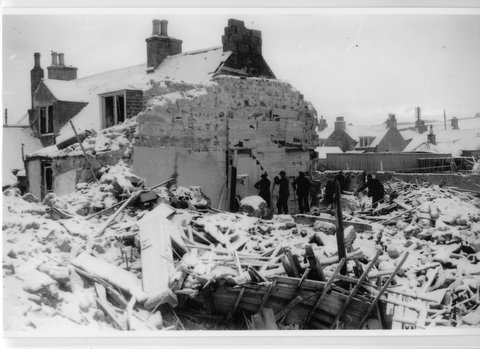
Rosehearty Air Raid: 29.01.1942

During the Second World War there were four enemy air raids on Rosehearty. The most serious of these took place at around 6.30 p.m. on 29th January 1942, 70 years ago today, when an enemy aircraft dropped 5 high explosive bombs over the town. Two bombs damaged the harbour wall and two small boats. Three bombs landed in the town: numbers 25 and 27 Pitsligo Street were completely demolished by a direct hit and several other houses sustained lesser damage as did the telephone and lighting systems. During the raid there were eleven fatalities, four women and seven children, including an evacuee from Glasgow.
The damaged buildings, the morning after the raid.


 The fatalities included 14 year old Dorothy Duncan who was killed by the blast from the bomb and whose gravestone at Peathill, by the dyke between the kirkyard and the road, demonstrates the great losses sustained by families during the war.


The names of those killed in the raid, along with names of those who died in other wartime incidents and in the armed services, are recorded on the War Memorial on the Cairnhill, overlooking Rosehearty.
An account of the air raid, as recorded in the official Civil Defence log may be read at the following link.
http://www.aberdeencity.gov.uk/education_learning/local_history/archives/loc_onlineexhibitioncivildefencerosehearty.asp